
UL leadership visits CERN to mark the first anniversary of Slovenia's full membership
Publication date: 16. 7. 2026To mark the first anniversary of the Republic of Slovenia becoming a full member of the European Organization for Nuclear Research (CERN), the Rector of the University of Ljubljana, Prof. Dr Gregor Majdič, and the Vice-Rector for Research and Development, Prof. Dr Gregor Dolinar, visited the world’s largest particle physics laboratory. At CERN’s headquarters in Geneva, they were welcomed by Dr Gautier Hamel de Monchenault, Director for Research, and Dr Jeff Wiener, CERN’s representative for cooperation with Slovenia. During the meeting, the hosts presented CERN’s key activities and discussed the importance of involving Slovenian researchers and students in world-class international research projects.
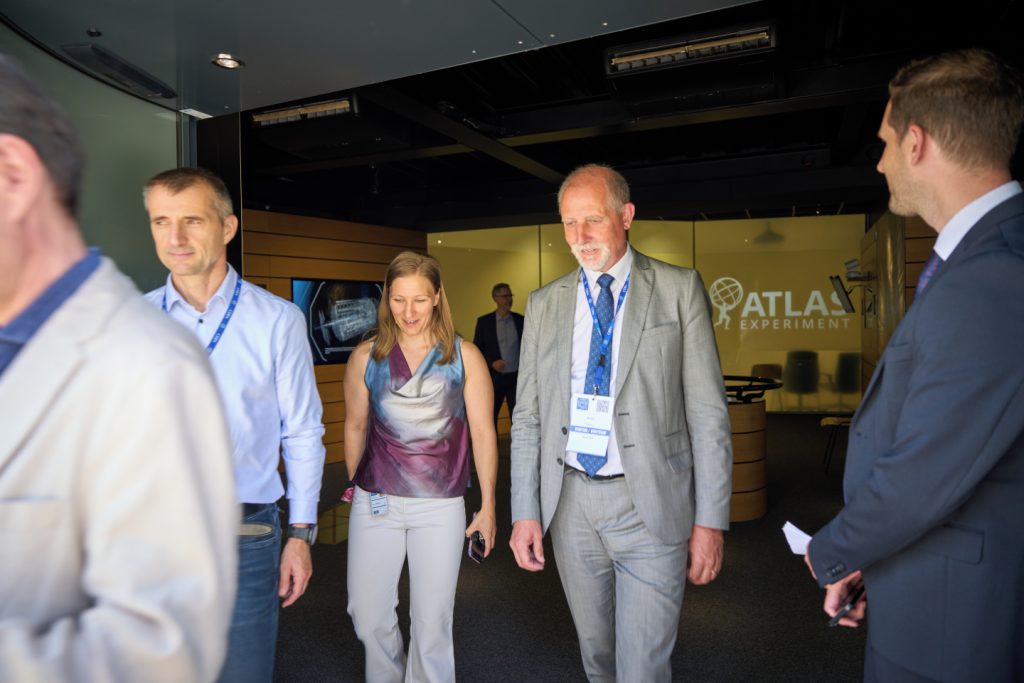
Particular attention was given to opportunities for further strengthening cooperation between the University of Ljubljana and CERN. Discussions focused on expanding the participation of Slovenian research groups in international experiments and increasing opportunities for young researchers to join training and exchange programmes. Slovenia’s full CERN membership also enables researchers from other disciplines at the University of Ljubljana—notably mechanical engineering, electrical engineering and computer science—to contribute to the development of future experiments.
Slovenian physicists have been collaborating with CERN since 1975, when they joined the OMICRON experiment under the leadership of Prof. Dr Gabrijel Kernel. Over the following fifty years, they have participated in numerous CERN experiments, most notably CPLEAR and DELPHI. Today, Slovenian researchers contribute to the ATLAS and LHCb experiments at the Large Hadron Collider (LHC), while both experimental and theoretical particle physicists from Slovenia continue to play an active role in CERN’s research programme.
Slovenian scientists also made an important contribution to the discovery of the Higgs boson in 2012. The next major scientific challenges include answering fundamental questions about the Universe, such as the nature of dark matter and why there is far more matter than antimatter. To address these questions, Slovenian researchers are participating in the upgrade of the ATLAS experiment and the High-Luminosity Large Hadron Collider (HL-LHC), which is expected to begin operation in 2030. They are also involved in the development of CERN’s next-generation accelerator, the Future Circular Collider (FCC-ee), which is planned to become operational in approximately 15 years.
Related events
Stay up to date

University of Ljubljana, Faculty of Electrical Engineering Tržaška cesta 25, 1000 Ljubljana